A while ago, I started taking photography classes.
Between assignments, I found myself scrolling through city skylines, landscape shots, and abstract patterns. Beautiful pictures. And something kept nagging me.
What if these pictures were quilted? What if free motion quilting wasn't just the finishing step in a quilt, but the way you made the whole thing? What if a quilter could sit down at her machine and stitch a picture into cloth?
If the term is new to you, free motion quilting means you drop your machine's feed dogs and guide the quilt by hand. You can travel in any direction, a lot like a pencil.
I tried to let the thought go. It kept coming back, telling me the world needs this.
Because I know so many quilters who've learned a free motion quilting design or two, stitched a stack of practice sandwiches, and then wondered what comes next. A practice sandwich is a small scrap quilt, top, batting, and backing, that you use to try a design before it goes near a real quilt.
This is my answer. It's called WholeCloth Draw.
Not a Quilt Pattern. A Quilting Pattern.
Most quilt patterns tell you how to cut fabric and sew it into a quilt top. Then they leave the quilting up to you.
WholeCloth Draw Spooky Cat: Launch Kit Page 13 of 22
WholeCloth Draw flips that around. There's no piecing at all. The quilting is the whole show.
A whole-cloth quilt is a quilt made from one single piece of fabric. Instead of a pieced top, the stitching creates the design. Quilters have been making them for centuries, usually with feathers and fancy grids.
WholeCloth Draw takes that old idea and turns it into a picture. You use free motion quilting to draw a scene with thread, one line at a time.
How it Works
Every WholeCloth Draw pattern follows the same few steps.
- Print and tape the outline. It prints at home on regular paper and tapes together into a full-size template.
- Trace it onto your fabric. You'll use a light-colored fabric so the lines show through.
- Make your quilt sandwich. Layer the fabric with batting and backing, and baste them together.
- Draw with thread. Free motion quilt along the lines and fill in each part of the picture.
- Bind and hang. Each pattern shows you how to add hanging tabs so it goes straight to the wall.
Every pattern also includes a labeled chart of the finished piece. It shows the thread color and the free motion quilting design I used in each part of the picture.
So if you're staring at the pumpkins wondering what goes there, you're not on your own. Borrow my plan, change it up, or ignore it completely. There are no quilt police here.
Who It's For
WholeCloth Draw is for you if you've done any free motion quilting at all. If you can drop your feed dogs and guide a quilt sandwich under a free motion foot, you have enough skill to start.
It's for the quilter who took a class and is hungry for a real project. And it's for the quilter who's been at this a while and wants something fun to hang up and show off.
If you've never tried free motion quilting, start with my free class, FMQ 101. You'll get your machine set up and quilt your first design in an afternoon.
Meet Spooky Cat
The very first WholeCloth Draw is Spooky Cat.
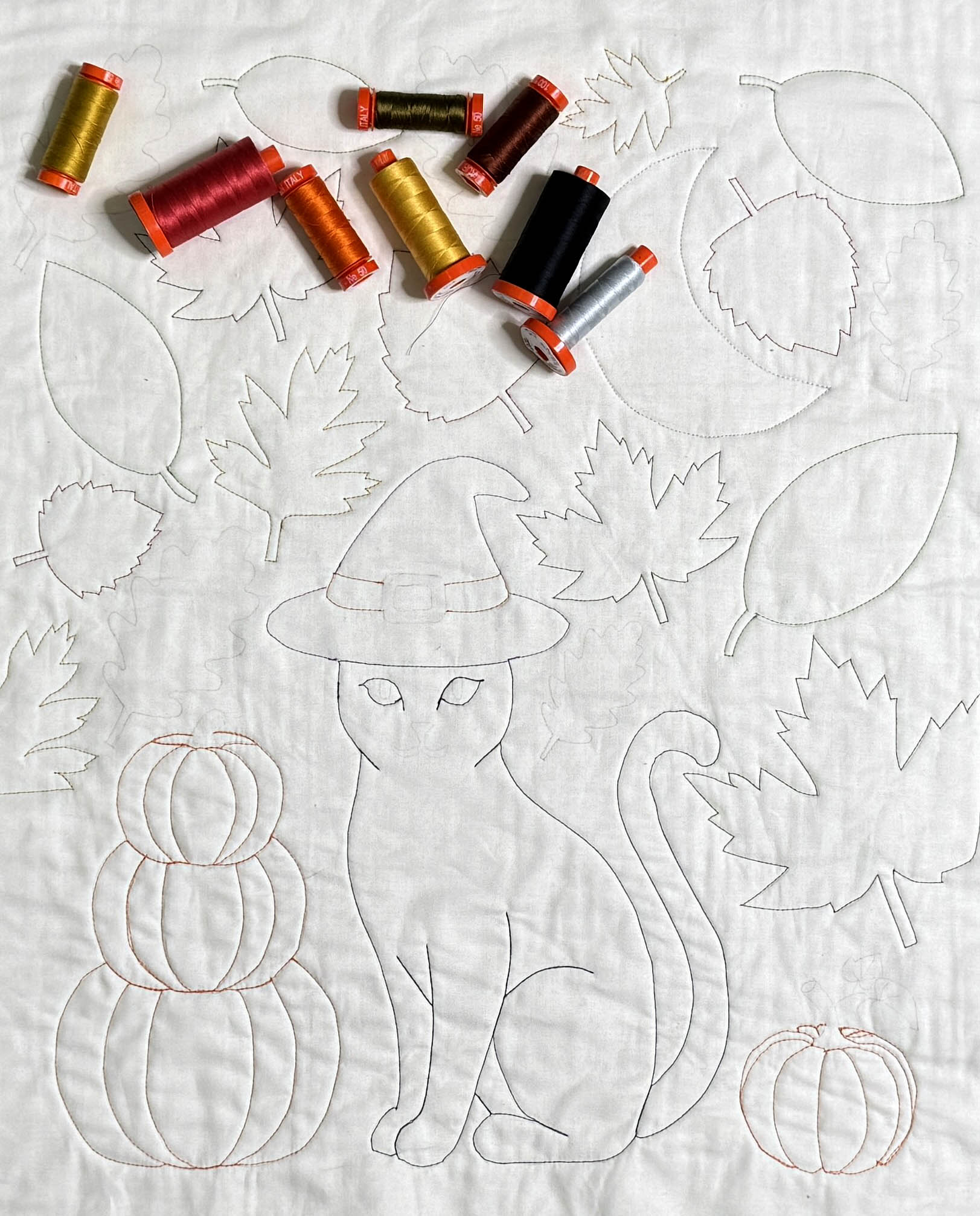
Black cats might be bad luck. But how bad can it be when he's wearing a floppy purple witch's hat in the middle of a pumpkin patch?
He finishes at 18" x 22", a nice size for a wall or door. You need 3/4 yard of light fabric, a scrap of batting, a little fabric for binding and hanging tabs, thread in a few colors, and about a weekend. There's nothing tricky in this one.
And he's not a make-it-once kind of quilt. He's the one you pull out of the closet every October, like an old friend who shows up for fall.
A winter scene is coming in December, too. I can't wait to show you.